Tokyo, 2025 November 14th
What is blend K?
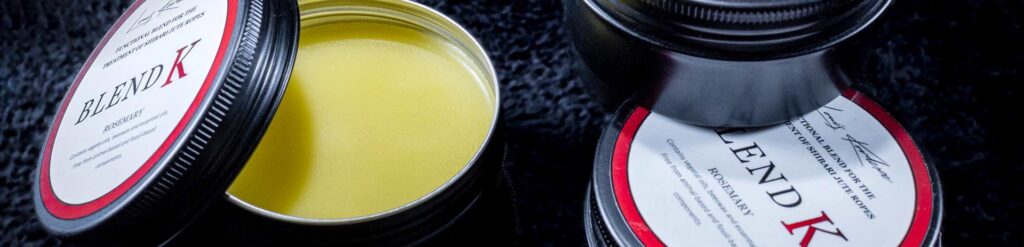
The blend K is a five-component oleogel (oil trapped inside wax micro-vesicles) optimized specifically for shibari jute rope oil conditioning. More details about oil conditioning process can be found here. This blend is the result of my experience over the years in rope conditioning, screening of oil–wax formulations and optimization.
Applied with bare hands, the blend penetrates the fibers to maintain flexibility and forms a protective and microbe-resistant surface film. This preserves stability, hygiene, and longevity of the ropes. The blend K formulation avoids the common pitfalls of oil conditioning products and processes that are inefficient or damaging to jute. Three fundamental qualities are reinforced:
Ease of application
A semi-solid gel that melts at hand temperature, spreading smoothly with a high absorption rate. It coats fibers evenly with a stable wax film, without dripping or requiring heat (high temperatures damage the structure of jute fibers and beeswax).
Rope durability
By reducing abrasive friction and creating hydrophobic, less microbe-friendly rope coating, it slows fiber wear and degradation.
Rope handling & feel
It reduces harsh friction while maintaining grip, increases rope mass and inertia, and gives the rigger better tactile feedback.

The basis of blend K
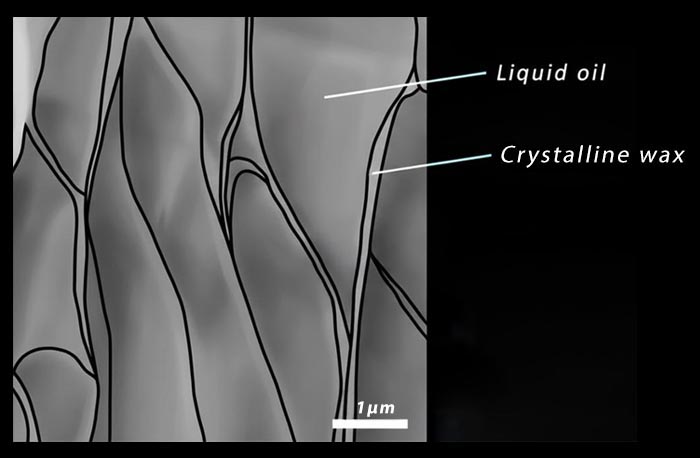
In cosmetic science, oleogels are networks of crystalline wax structures that encapsulate oils inside microscopic vesicles. These balm like materials are used in lipsticks and high-end skincare because they offer stability, controlled oil release, and a precise melting behavior. The blend K is such an oleogel and follows the same principle, but it is optimized specifically for the needs of shibari jute rope oil conditioning.
Blend composition
Its core is a mix of oxidation-resistant emollient oils (based on camellia and jojoba oils) that keep the fibers supple without turning rancid. These oils are held within a matrix of beeswax and vegetable wax, which forms the occlusive crystalline vesicles responsible for the blend’s structure. A cohesive agent binds the system together, preventing phase separation and the formation of hard lumps that would otherwise be hard to melt or unevenly coat the rope. A trace of essential oils such as lavender or rosemary can be added purely for fragrance, never in amounts that would alter the system’s stability.
How it works
The melting point of the blend is tuned balancing all components to achieve the ideal state: firm and clean in the jar, yet soft enough to melt instantly under the warmth of your hands. No heating tools are ever required which prevents damages to the jute fibers.
When applied to a rope, the micro-vesicles break under pressure and release the oils. These oils move into the jute’s cellulose and hemicellulose micro-voids through capillarity, bringing plasticity and flexibility back into the fiber structure. The wax, unable to migrate inward due to its high viscosity, spreads across the outer surface and settles into a uniform, hydrophobic film that protects against friction, humidity, and microbial growth.
Oil migration completes within roughly forty-eight hours, and full rope saturation typically stabilizes after three or four conditioning cycles. The result is a rope that becomes smoother, stronger, heavier, and more responsive in the hands of the rigger.
Disclaimer
The information provided is based on my experience and established cosmetics and materials-science literature.
References
– Beeswax Book, Chapter 1 – 2016, Stefan Bogdanov.
– Structure and thermal properties of beeswax-based oleogels with different types of vegetable oil – Grasas Aceites 71 (4), 2020, M. Pang et al.
– Cryo-EM to reveal the microscopic structure of lipstick – 2025, KOSÉ Corporation and Tohoku University.
↰ Back to Resources and articles page