Shibari Jute Rope Oil and Wax Conditioning

Tokyo, 2025 December 11th
I originally wrote this article about shibari jute rope oil and wax conditioning to help my students obtain better ropes earlier in their journey. Jute aging can take a long time if not done properly. After publishing an initial article and video explaining how to condition new jute ropes, this follow-up focuses specifically on oil conditioning and its role in ongoing rope maintenance. I hope it will help understand how oil conditioning works and how to keep your ropes the way you like.
Why jute rope treatment is essential
As seen before, untreated jute ropes are abrasive, stiff, and prone to shedding. They irritate the skin, generate high friction, and handle poorly, making every pull require unnecessary effort from both partners. Without conditioning, ropes degrade faster due to humidity, bacteria, and mold growth, and their resistance turns control into struggle rather than flow for both you and your partner.
Conditioning solves these issues. The applied oil conditioning smooths the rope’s surface, enhances glide without removing grip, and transforms how the rope behaves in the hands. Lower friction makes movements easier and more fluid, reducing physical strain during tying. The protective wax film minimizes mechanical wear, while the oils penetrate the fiber structure, restoring flexibility and creating a hydrophobic barrier that slows mold and bacterial development.
In addition, as the rope core saturates with oils and the surface forms an even wax coating, the rope gains mass and inertia. This increased weight provides the rigger with clearer tactile feedback and a more grounded sense of the rope’s motion, resulting in more controlled, stable, and responsive handling.
This article provides the foundational framework on which the blend K is built.

Key phenomena of oil conditioning
Oil migration
Oil migration is the first thing that happens when you condition a rope. The oils move inward through capillarity and concentration gradients, gradually spreading from the surface into the core. By penetrating fibers, oils plasticize and soften the fibers, reducing internal brittleness and increasing fiber pliability. However regular handling slowly strips the outer layers, pulling oils outward again, which is why periodic re-application (when the ropes feel rough and dry) becomes necessary to keep the rope balanced and healthy.
Hydrophobicity (water repellency)
As these oils make their way through the fibers, they also change the rope’s relationship with moisture. Like cotton, jute fibers are porous and tend to absorb water. Jute naturally contains about 10% water and is porous, alkaline, and an ideal environment for bacteria and mold. When oils fill these voids, they repel and limit how much water the fibers can absorb.
| Jute | Cotton | |
| Cellulose | 64% | 90-95% |
| Hemicellulose | 12% | |
| Lignin | 12% | |
| Water | 10% | Highly absorbent |
| Others | 2% | 5-10% |
On the other hand, waxes unlike oils, cannot migrate inside the micro-voids due to their high viscosity; instead, they settle on the surface and forms a protective hydrophobic, mildly antimicrobial barrier film. This is the case of largely used beeswax.
Surface wear
Over time, surface wear becomes inevitable. Abrasion gradually thins or removes the wax film, exposing fibers to friction, humidity, and mechanical stress. A fresh application of blend restores the surface, reinforcing protection and reducing direct fiber damage.
Rope saturation
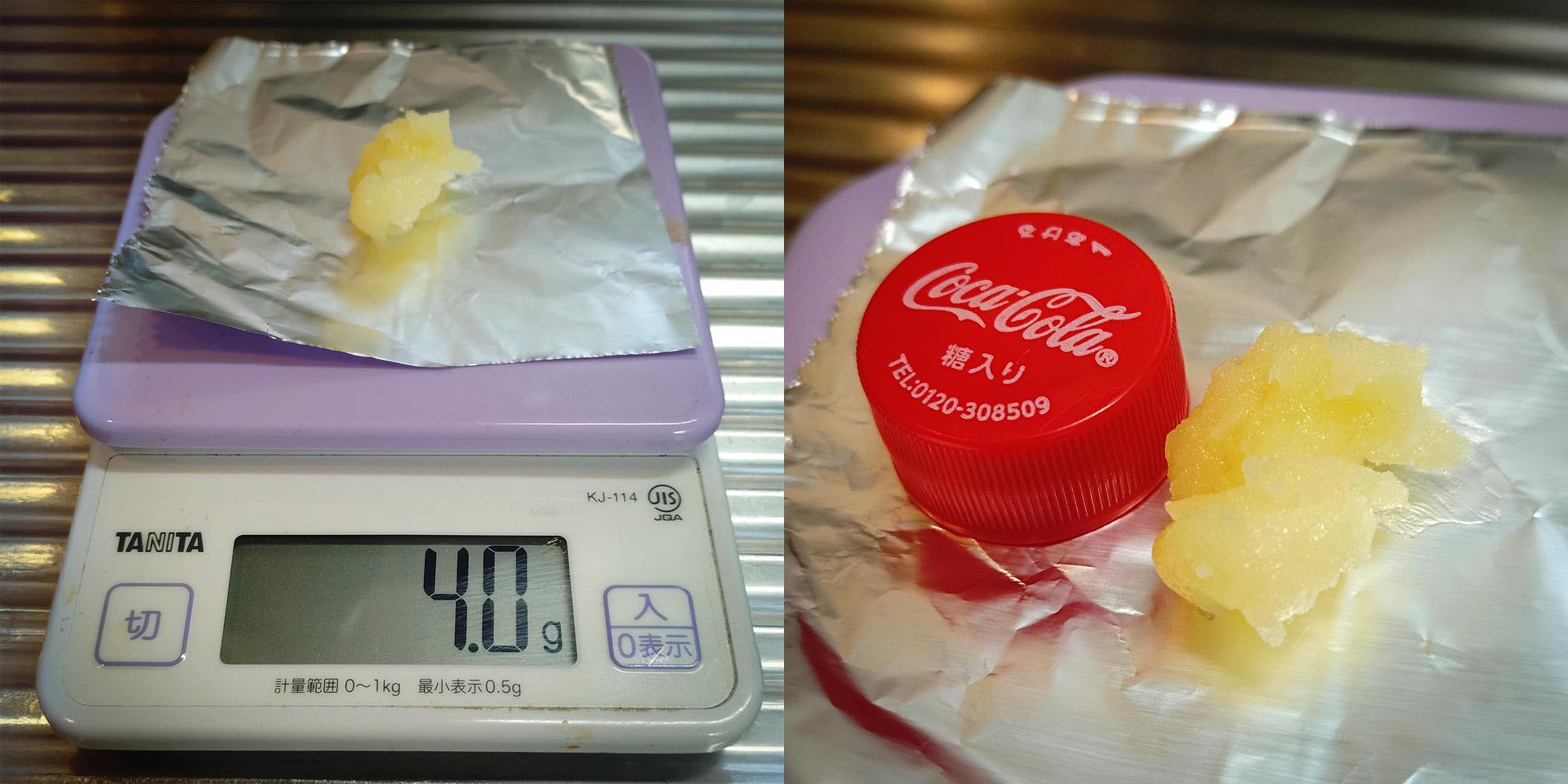
As the rope absorbs more oil and wax, it “fills up” and approaches saturation. Once saturated, it can no longer absorb additional blend, and any excess remains on the surface, making the rope greasy (note that oil migration into the fiber core takes time. If too much blend is applied at once, an unsaturated rope may temporarily feel greasy before the oil fully migrates inward.). The amount a rope can absorb depends on its type, length, manufacturer, fiber condition etc… making it difficult to establish exact quantities. Roughly in total, a standard 6 mm, 8 meters (26 feet) jute rope can take in roughly 12–15 grams (0.4–0.5 ounce) of oil/wax which represents around a 10% increase in mass. Each time for one rope of 8 meters (26 feet) I apply about a marble sized chunk of oil/wax blend as shown on the picture below.
With each application, the rope absorbs the blend into its core and gains weight. Aside from minor losses during handling (e.g., residue on hands), most of the blend’s weight is retained by the rope, as shown in the images below.
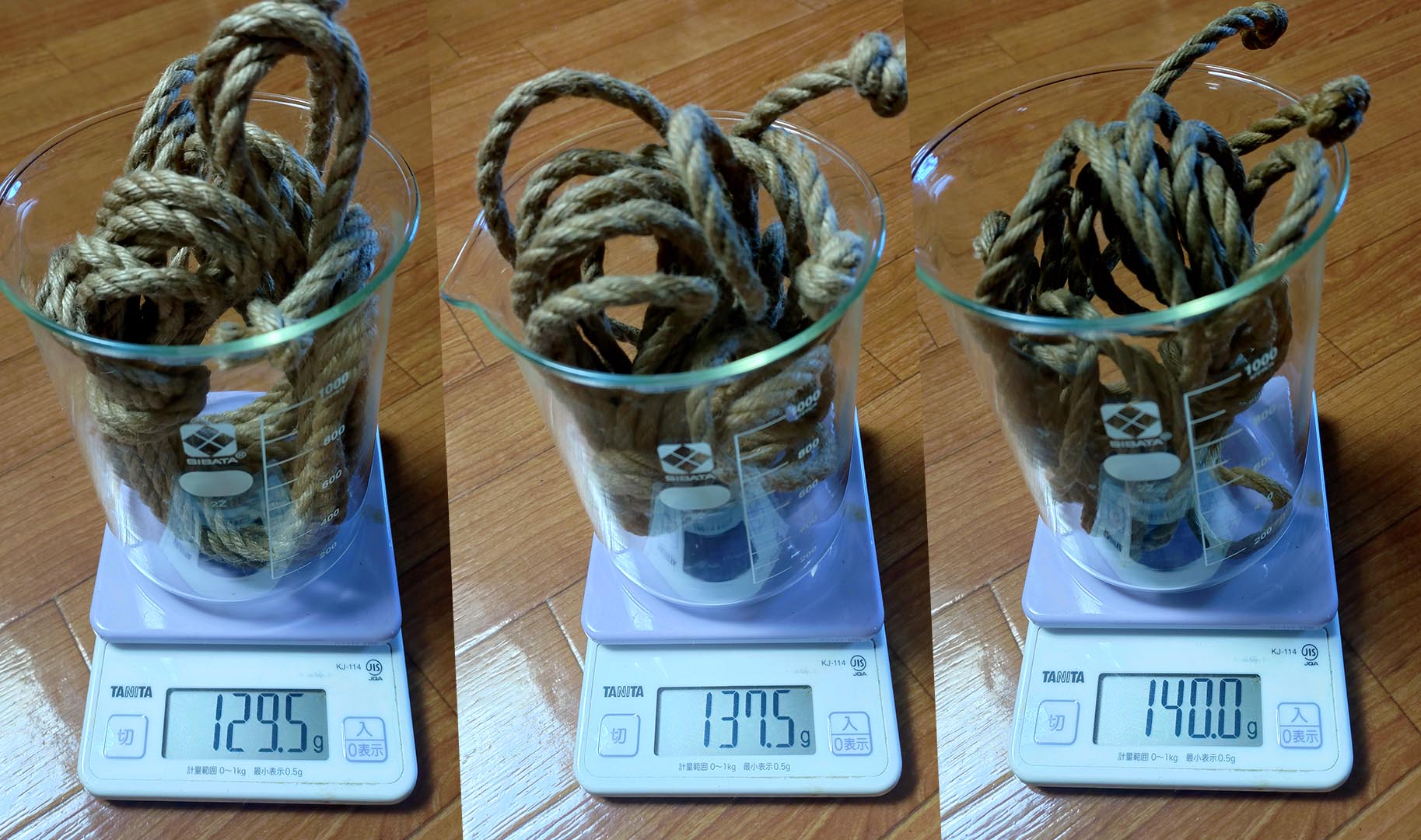
This added weight gives the rope more inertia and makes its movements more stable and readable in the rigger’s hands. Too much product, however, only makes the surface greasy and offers no additional benefit. Again, these figures and proportions will vary depending on rope length, maker, and fiber condition. What matters is the overall behavior and trend, allowing you to understand how your rope evolves and adjust its conditioning accordingly.
Melting point control
The melting point of the blend is important. Liquid systems are messy, drip everywhere, and waste material on application fabrics. On the other hand, solid wax require heating, which risks damaging the rope (see the treatments to avoid below). A “semi-solid blend” with a carefully controlled melting point applies easily in one single step, and stays exactly where it needs to be.
Oxidation resistance
Finally, oxidation must be considered. Oils rich in unsaturated fatty acids tend to break down into aldehydes and ketones, which cause rancid odors and sticky residues making the ropes unpleasant to handle. Using oxidation-resistant oils combined with wax structures that limit oxygen exposure helps preserve the rope’s feel, smell, and long-term performance.
Re-oiling for rope maintenance
Jute continues to evolve under friction, humidity, and repeated use. Oils are gradually depleted and the wax film thins over time. Periodic maintenance is necessary and if it is spaced too far apart, the rope dries, stiffens, and wears faster. Early in its life, conditioning should be relatively frequent; later, intervals can extend as the rope stabilizes. Of course these intervals depend on how often and how intensely the ropes are used. In my experience the frequency can look like:
・first oiling on day 1
・second oiling 10 days to 2 weeks later
・third one around 2 months later
・fourth one around 6 additional months later
・Then roughly once per year
Finally, ropes are a consumable. No maintenance protocol makes them eternal. Even well-conditioned jute will eventually lose strength and structural integrity and must be replaced when wear becomes significant.
Treatments and materials to avoid for oil conditioning
Some approaches to rope conditioning are popular in the community, but several of them fail in practice. Below are the methods I deliberately excluded over time when conditioning my ropes and formulating my blends, along with the reasons why they are unsuitable for jute ropes.
Using oils alone
Using oils alone may seem appealing because it is simple. Oils soak into the fibers and improve flexibility, but without wax they leave the rope with almost no protection against abrasion. Furthermore during use, the rope’s outer layers lose oil quickly, creating a concentration gradient that pulls out even more oil from the core by capillarity. The result is a rope that dries out fast and requires constant reapplication. Without a protective wax film, oil depletion happens faster.
Using beeswax alone
Using beeswax alone has the opposite problem. While it creates a surface coating that protects against wear, its viscosity prevents it from migrating into the micro-voids of the fibers. It simply cannot penetrate deep enough to restore flexibility or nourish the inner structure of the rope.
Heating ropes (in an oven or with other tools)
Heating ropes is a widely recommended but potentially rope damaging practice for melting the beeswax or other high melting point mixtures. Although lignin, hemicellulose, and cellulose decompose at relatively high temperatures, the composite structure of jute fibers becomes vulnerable at lower temperatures.
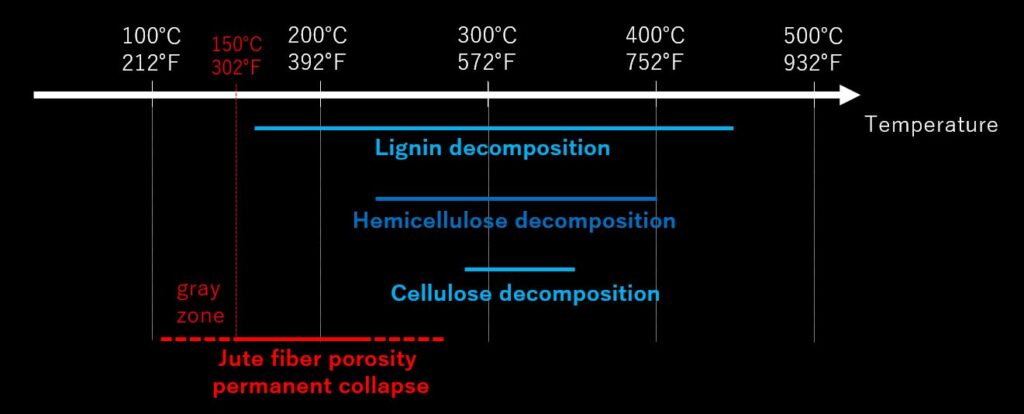
Around 100℃ (212℉), the rope loses water in a reversible way. But at roughly 150℃ (302℉), the empty voids left by evaporated water cause cellulose microfibers to collapse and fuse. This destroys the fiber’s porosity and permanently reduces its ability to re-absorb water or oil. The rope becomes less sensitive to oil conditioning. It remains drier, more brittle, and structurally weaker especially under elongation and tension. Although it is true that the lignin, hemicellulose and cellulose molecular backbones are unaffected, the fiber’s structure is damaged. And while the exact timing of permanent damage is not clear, it’s prudent to avoid heating jute ropes above 100℃ (212℉), a margin of safety far below the failure point, to preserve their mechanical properties and integrity.
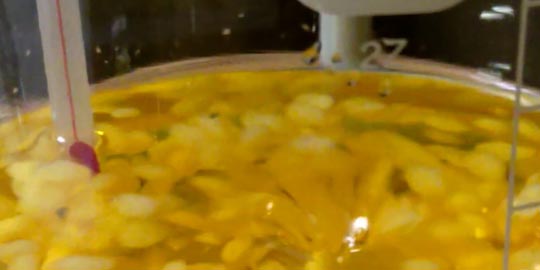
The other issue with heating is the damage done to the beeswax. At temperatures above 100 ℃ (212℉), volatile compounds of beeswax evaporate, molecules break, and the wax crystalline structure rearranges.
This becomes even more pronounced above 140 ℃ (284℉). Beeswax that was originally soft and plastic turns hard and brittle, providing poor coating-film protection.
As a result, careful control of the temperature to which ropes and beeswax are exposed is essential.
Human sebum
The idea that ropes can “naturally condition themselves” on a model’s skin is more myth than reality. Sebum is acidic and stable on human skin to prevent bacteria and fungi proliferation, but when transferred to alkaline, porous jute fibers, it quickly turns into a nutrient film for these bacteria and fungi which can lead to unpleasant odors (like an old cotton bath towel). In addition, the amount of sebum involved is negligible: the human body produces roughly one gram of sebum per day across its entire surface (not evenly distributed), so the quantity that actually comes into contact with ropes on limited areas of the body is minimal. In contrast, a single 6mm, 8 meters (26 feet) jute rope can absorb up to 12–15 grams (0.4-0.5 ounce) of blend when saturated. As a result, human sebum is neither hygienic nor quantitatively meaningful.
Using highly unsaturated oils (such as horse oil, olive oil…)
Oils with high content of unsaturated acids oxidize quickly and break down into decomposition byproducts that smell unpleasant (like an old humid basement) and become sticky on the rope. Even if they seem nourishing at first, they destabilize the rope in the long run (over the course of a few months). An example of such oil is the horse oil (bayu 馬油 in Japanese) which has always been highly regarded in Asian cosmetics for its legitimate strong moisturizing effect on human skin. Its reputation probably led to its use on shibari ropes in Japan, but it is not the best choice for our purposes.
Using mineral oils (like baby oil or Vaseline)
This is a personal preference not based on objective facts. Inert, non-polar hydrocarbons of mineral oils coat the fibers but do not bond with them. They leave a greasy, slippery residue that gives the rope an unpleasant microfiber-like feel that I personally dislike.
Disclaimer
The information provided is based on my experience and established cosmetics, textile, and materials-science literature.
References
– Effect of heat treatment on the mechanical properties of jute yarns – Journal of Composite Materials 2021, 0(0) 1–16, Y Ben Smail et al.
– Mechanical properties of jute fiber using the heat treatment method – High Performance and Optimum Design of Structures and Materials IV, Tsukasa Nagasaka et al.
– Beeswax – composition and analysis – Bee World 1980, 61 (2): 47-62, Tulloch.
– Beeswax Book, Chapter 1 – 2016, Stefan Bogdanov.
– Structure and thermal properties of beeswax-based oleogels with different types of vegetable oil – Grasas Aceites 71 (4), 2020, M. Pang et al.
– The Future of Functional Clothing for an Improved Skin and Textile Microbiome Relationship – Microorganisms 2021, 9, 1192, Rosie Broadhead et al.
– Cryo-EM to reveal the microscopic structure of lipstick – 2025, KOSÉ Corporation and Tohoku University.
– Improvement of Mechanical, Thermal, and Physical Behaviors of Jute/Cotton Biocomposites Reinforced by Spent Tea Leaf Particles – Compos. Sci. J. Compos. Sci. 2022, 6, 145, Mohammed M. Rahman et al.
↰ Back to Resources and articles page